The Big Blog on Feasibility Studies
1. Before You Launch That Capital Campaign, Read This: A Plain-English Guide to Feasibility Studies
You’ve got a big idea. Maybe it’s a bold vision for the future that involves a new building, a program expansion, or the most ambitious fundraising campaign your organization has ever attempted.
But before you start printing pledge cards, there’s one question worth sitting with: Is this actually doable? To find out, you may need a feasibility study.
What is a feasibility study, the short version
A feasibility study (sometimes called a campaign readiness assessment or philanthropic planning study) is a structured process of analyzing your data and asking your most likely donors, board members, and community stakeholders: Would you support this, and at what level?
It’s a candid, confidential assessment typically conducted by a third-party consultant that helps your organization understand whether the goal you have in mind is achievable, at what dollar amount, and within what timeframe.
First, You Need a Case for Support
Before you can sit down with a single donor, you need to be able to answer one question clearly: Why should someone invest in this right now? That’s what a case for support does. It’s the foundational document that defines your vision, frames the need, introduces the campaign, and makes the ask — and it’s what your consultant will use to anchor every interview conversation.
A strong case for support becomes the backbone of everything in your campaign: grant proposals, donor meetings, campaign materials, appeal letters, even your website. Getting it right before or during the feasibility study means every interview respondent is reacting to the same story, which makes the data you collect far more useful.
Want a step-by-step walkthrough? Grab our FREE guide to writing a Case for Support on your own below:
2.The interviews bring qualitative understanding
Most studies follow a similar format. A consultant (ideally someone outside your organization, so respondents feel comfortable being honest) conducts 15–35 one-on-one interviews with a cross-section of your donor base. This typically includes:
Your top current donors and lapsed major gift prospects
Board members and volunteers
Community and civic leaders with ties to your cause
Foundation contacts and other institutional funders
The interviews are conversational and confidential. Respondents are asked about their connection to your mission, their perception of your organization’s leadership and financials, their awareness of the proposed initiative, and whether they’d consider a gift, and at what level.
The data analysis reveals quantitative facts and likelihoods
Concurrently, your consultant completes a thorough analysis of your donor data, starting with a donor capacity picture. Using a combination of interview responses, wealth screening data, and giving history, each prospect is assigned an estimated annual giving capacity. Taken together, these figures tell you something critical: the gap between what your donors are currently giving and what they’re capable of giving.
To make this concrete, consider a mid-sized nonprofit that went through this process before a capital campaign. Their 1,500 donors had given a combined $6.7M in their most recent gift cycle. But when capacity was modeled across that same pool, the estimated annual giving capacity came out to over $120M. It is normal to have a gap between current giving and potential giving, and that is where the work of your campaign will begin.
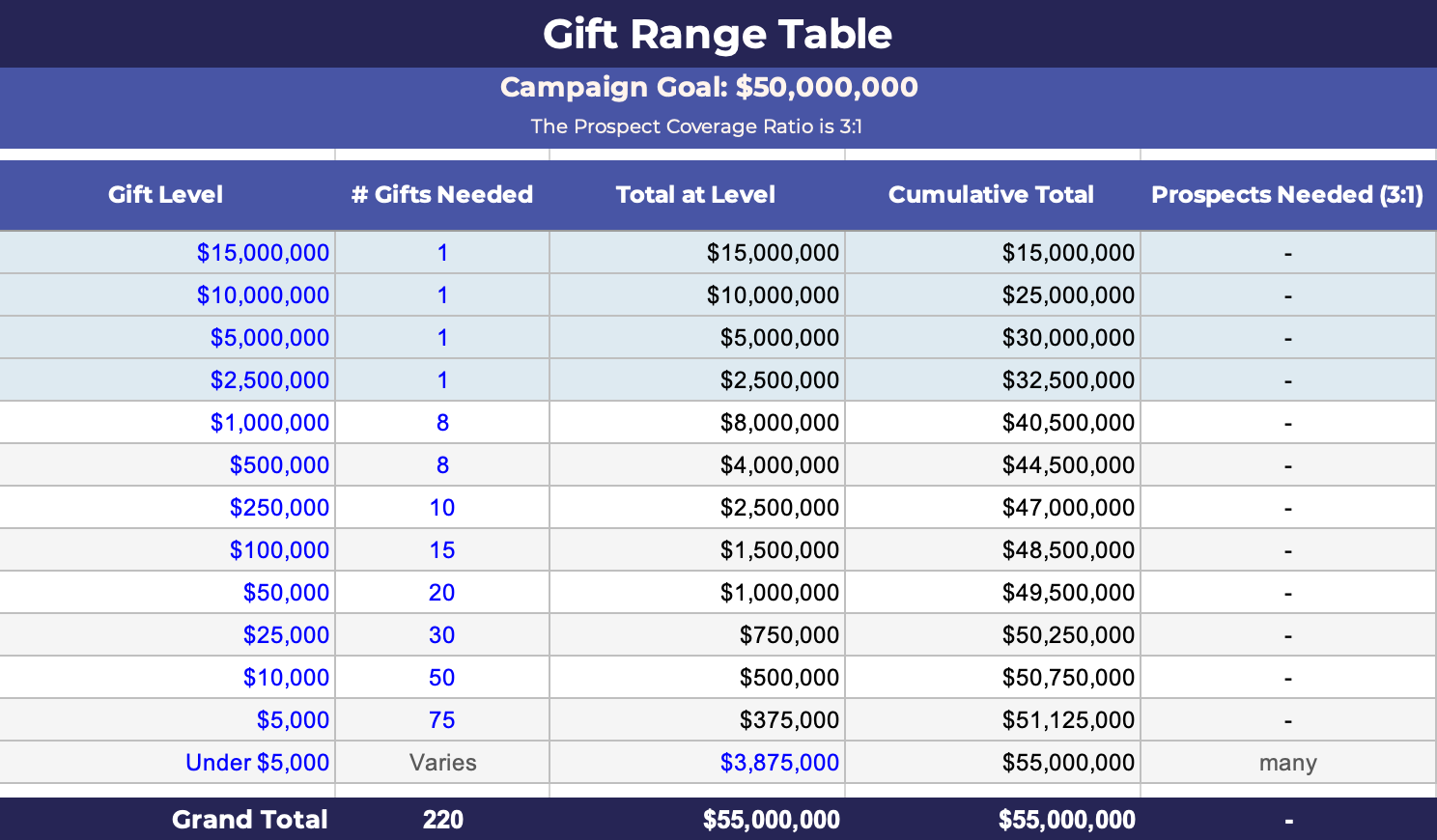
From there, the data is layered into a gift table: a structured pyramid that shows how many gifts you need at each dollar level to reach your goal, and the names of the donors that can likely donate at each level. For a $50 million campaign, that might look like one gift at the $10 million and $5 million levels, and onward down to 8 gifts at $500K — with the top tier of transformational gifts representing 55% of the total campaign goal. The table makes it immediately clear which levels are well-covered by your current donor pool and where the gaps are.
That’s where coverage ratios come in. The industry standard for warm donors is a 3:1 ratio: for every gift you need, you want three qualified prospects in the pipeline. If the donors are not close or have not been cultivated, you may need a 5:1 ratio. A study will map your existing donor base against one of these benchmarks at each gift level. You might find you have 111 prospects identified at the $100K–$249K level (well above what you need) but only one prospect for a gift range where you need six. That imbalance tells your team exactly where to focus cultivation before you ever make an ask.
Beyond the numbers, a good study also codes for sentiment and readiness. Donors are segmented not just by capacity, but by where they are in their relationship with your organization: warm and ready to be asked, actively engaged but not yet at campaign level, or lapsed and in need of re-engagement before they’re solicitation-ready. In the example above, of 306 portfolio-level donors, 14 were flagged as Tier 1 (strong potential, high capacity, primed for a leadership ask), 95 as Tier 2 (consistent donors giving at portfolio level), and 197 as Tier 3 (lapsed or giving well below their capacity).
The final report brings all of this together: a recommended goal range, a projected donor pyramid, a gap analysis flagging where you need to build the pipeline, and a timeline that reflects the true cultivation work ahead. Some organizations go in expecting to raise $50M and come out of a feasibility study with data that says $35M is more realistic. This does not mean the campaign isn’t viable, it is a reflection that the data showed they weren’t quite ready to ask the right people for the right amounts.
3. What a Feasibility Study Is Not
Here’s where a lot of managers get tripped up: a feasibility study is not a solicitation. Donors are not being asked for a gift, they’re being invited into a conversation.
When conducted well, a feasibility study cultivates donors: they feel valued, heard, and included. Many walk away more engaged with your mission than before the conversation started.
It’s also not a guarantee. If the study comes back showing your $50M goal needs to be scaled to $35M, that’s not failure; that’s the study doing exactly what it’s supposed to do. A responsible leader will recognize that it is better to know now than a year into a campaign that’s running out of steam.
When Should You Do One?
Not every fundraising effort needs a full feasibility study. For annual fund campaigns or smaller initiatives, the cost and time investment may not make sense. The right trigger isn’t a dollar figure, it’s a ratio. A good rule of thumb is if your campaign goal is 3x or more of your annual fundraising revenue, that’s when the ask represents enough of a stretch that you genuinely can’t assume readiness. A $5M campaign at a small regional nonprofit is a very different level of stretch than a $5M campaign at a major hospital system. The feasibility question scales with your organization. Beyond that ratio, a study is strongly worth considering when:
You’re planning a campaign that would represent a significant departure from your historical fundraising track record
Your organization is significantly expanding a program or service
You’re launching a first-ever major gifts program
You’ve experienced recent leadership transitions and want to gauge donor confidence
Your last campaign struggled and you need to rebuild trust before going back to donors
The Hidden Value: Organizational Alignment
Beyond the numbers, there’s something else a good feasibility study gives you: organizational alignment.
The process of preparing for a study – identifying your prospect pool, articulating your case for support, clarifying your leadership structure – forces conversations internally that most organizations need to have anyway. You’ll surface disagreements, sharpen your messaging, and identify gaps in your donor relationships before you’re in the middle of a campaign.
The preparation for a feasibility study makes you a stronger fundraising organization.
Ready to Move Forward?
If you’re weighing a major fundraising initiative and wondering whether the timing is right, a feasibility study can give you the clarity and the confidence to move forward or it can help you course-correct before you’re too far into the campaign. Either way, you’ll be making your decision based on data, and a data-informed plan is one of the most valuable things you can have.
Thinking about a feasibility study for your organization? Download our Campaign Readiness Checklist below: